

Not a Monster, Not a Messiah: Treat AI Like a Power Tool — With Real Guardrails
History shows every breakthrough sparks fear before it sparks trust. AI is simply next. With the right guardrails, it works for you, not against you.

Welcome to Signature Sunday.
Once a month, I step back from the day-to-day to look at the bigger forces shaping how we build trust in business and real estate.
This week, we zoom out to ask: Why does every leap forward — from cars to elevators to AI — feel terrifying before it feels normal? And what do professionals like us do when the world panics?
AI isn’t here to replace you. It’s here to work for you.
If we had listened to the “progress police” of history, we’d still be walking dirt roads, tugging donkeys, or hitching up horses.
The first cars? Dubbed “devil wagons” in local papers at the turn of the 20th century, according to Sangamon County History.
Electricity was branded dangerous during the “War of the Currents.” Public electrocutions of animals were staged to frighten crowds, as Smithsonian Magazine recalls.
Early telephones were suspected of spreading illness and corrupting manners — a panic revisited by The Atlantic.
Elevators were dismissed as “death traps” until Elisha Otis famously cut the hoisting rope during a live 1854 expo, an event chronicled by Britannica and later celebrated by Time.
Progress always feels dangerous before it becomes indispensable. AI is no different.
Fear Always Comes First
Automobiles frightened horses and rattled communities that tried to regulate or even ban them. Illinois papers sneered at the “devil wagon” as a public nuisance, according to Bullitt County History.
Electricity sparked fear campaigns, including gruesome demonstrations, until safety standards and testing made it reliable, as Wikipedia’s War of the Currents entry documents.
Telephones were treated as unhealthy and corrosive to morals before etiquette guides and telecom standards normalized them, The Atlantic noted.
Elevators were dreaded until Otis’ brake system transformed them into the backbone of skyscraper living, Time reported.
Fear always makes the headlines first. Guardrails come later.
What People Fear About AI Today
We’re in the same cycle now:
Voter deception. A deepfake of President Biden’s voice was used in a robocall that urged New Hampshire voters to stay home — a case highlighted by the Election Innovation Lab.
Family fraud. The Federal Trade Commission has warned repeatedly that scammers are using AI-powered voice cloning to trick relatives into sending money.
Bias. ProPublica exposed how AI risk assessments unfairly flagged Black defendants, while Reuters reported on Amazon’s decision to scrap its AI recruiting tool after it quietly discriminated against women.
The technology isn’t inherently broken. The absence of rules is.
✦ Paid-Only Preview
Here’s where the story gets practical. We’ll walk through how fear gave way to trust for past innovations — and how the same guardrails are already being built for AI today.
✦ A note for free readers
You’ve just read the opening of this Signature Sunday essay. If you’re a free subscriber, this is where today’s read ends — but the full piece is waiting for you.
Paid subscribers continue below with:
The historical pattern of fear → guardrails → trust
Why AI is a tool, not a deity
The real guardrails being built now (EU AI Act, NIST AI RMF, FTC enforcement)
A practical AI Risk-Ready Checklist to apply right away
Signature Sunday runs once a month, every third Sunday. If you’d like full access to these deeper essays — and the tools that go with them — you can upgrade here 👇
Panic → Guardrails → Everyday Utility
Every innovation that once felt like a monster became part of everyday life once we built rules around it:
Automobiles were once “devil wagons” until licensing and road rules turned them into the backbone of modern mobility (Sangamon County History).
Electricity went from fire hazard to household staple after safety testing and building codes, according to UL.
Elevators went from terrifying free-fall risks to skyscraper enablers after Otis’ brake demo (Britannica).
Telephones went from moral panic to everyday necessity, as The Atlantic reported.
AI is simply the next chapter in this book.
AI is a Tool, Not a Deity
In Sweden, the largest mammography trial to date showed that AI-assisted radiologists caught more cancers with fewer false positives while cutting workload by nearly half, The Lancet Oncology reported.
In the U.S., more than 500 AI-enabled medical tools have been cleared by the FDA, but none operate independently. Doctors still make the final call, according to The Washington Post.
The lesson is clear: AI performs best with humans in the loop.
Guardrails Already Taking Shape
EU AI Act (2024–2026): Europe’s landmark law phases in bans on manipulative AI systems and mandates transparency, according to the European Commission.
NIST AI Risk Management Framework: A voluntary U.S. playbook that encourages organizations to govern, map, measure, and manage AI responsibly, according to NIST.
FTC Enforcement: Fake reviews, misleading AI claims, and deceptive bots are now explicitly illegal. The FTC finalized a rule in 2024 banning the sale of fake or AI-generated reviews, with fines topping $50,000 per violation, Reuters and The Verge reported.
The guardrails are already being built.
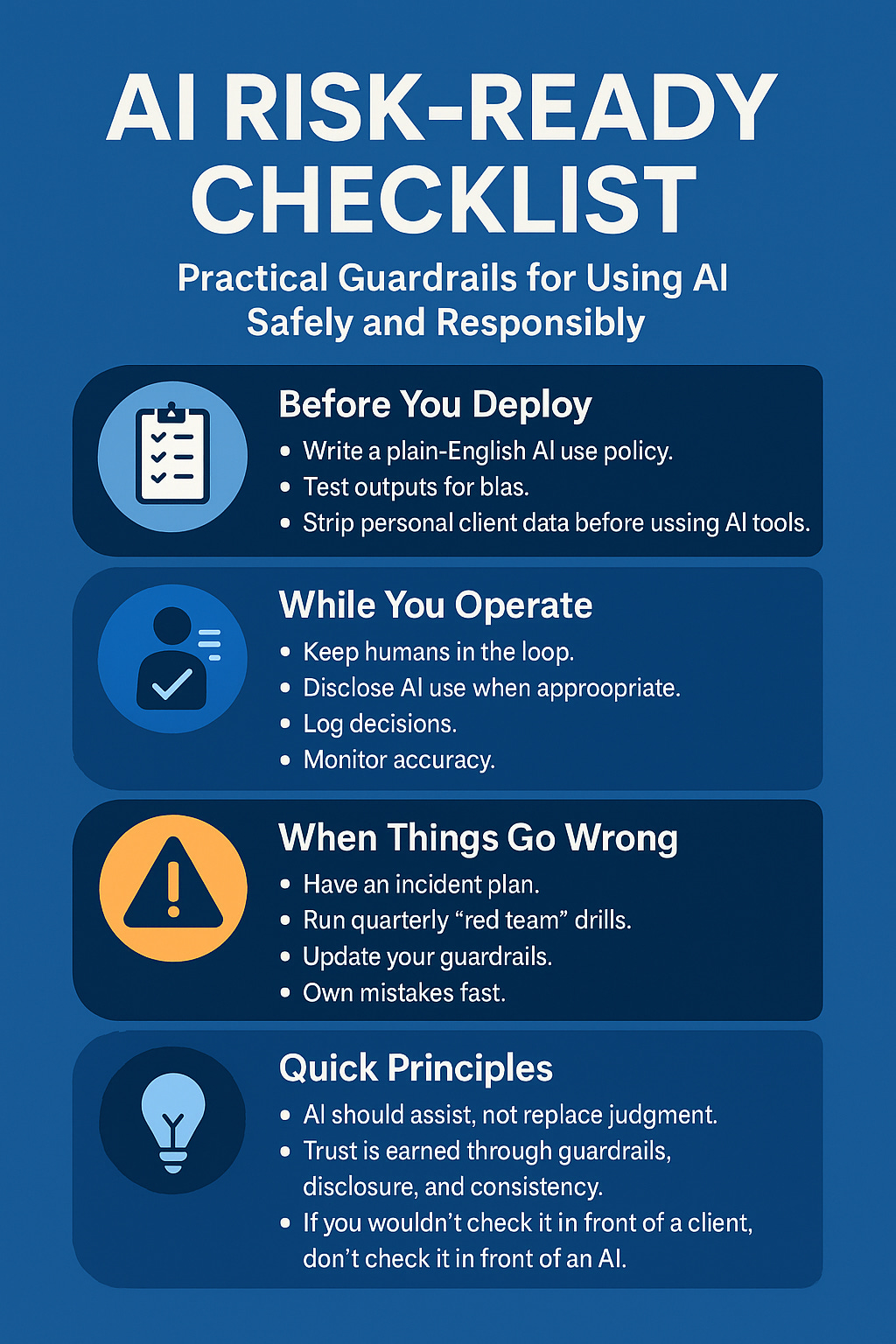
The Play: AI Risk-Ready Checklist
Here’s a starter set of guardrails you can put in place right now:
Before you deploy
Write a plain-English AI use policy
Test outputs for bias
Strip personal client data
While you operate
Keep humans in the loop for final sign-off
Disclose AI use to clients
Log approvals and changes
When things go wrong
Have an incident plan
Run quarterly “red-team” drills
👉 Download the full AI Risk-Ready Checklist (PDF) here: offmarketinfluence.com
The Brief: Trust Comes From You, Not the Tool
AI won’t replace your judgment, empathy, or ability to earn trust.
History shows that fear fades once guardrails are in place:
Devil wagons became SUVs
Fire-spitting wires became Alexa plugs
Death-trap elevators became luxury penthouses
AI is simply next.
This is what Signature Sunday is about: clarity in the noise.