

The Principle Tax
What does doing the right thing cost, and why is it still worth paying?


There’s a quiet scene from Nothing But the Truth (2008)… shared on YouTube under the title Undercover Justice: The Agent Who Risks Everything to Expose the Truth — that still echoes.
Rachel Armstrong, the journalist on trial, is in the judge’s chambers with her attorney, Albert Burnside, the special prosecutor, Rachel’s newspaper’s attorney, an FBI agent, and the judge.
After a tense exchange, Burnside asks the judge for a private word with just himself, his client, Rachel, and the newspaper’s lawyer. The judge nods and grants them access to his adjoining private library.
Behind that door, just the three of them, Rachel and Burnside share a quiet, charged moment, while the newspaper’s lawyer looks on, animated but silent.
And it’s there that Rachel says, low but unwavering:
“A man leaves his family to go to jail to protect a principle, and they name a holiday after him. A man leaves his children to go fight in a war, and they erect a monument to him. A woman does the same thing, and she’s a monster. If we back down, what are we saying, Albert — trust reporters as long as they’re not mothers, because they’ll crack.”
She’s not just pointing out gender bias.
She’s exposing the brutal double standard, the unspoken tax of principle, paid by those who don’t fit the world’s preferred profile for sacrifice.
You See It in Real Estate, Too:
When you tell a seller their house is overpriced, and they leave for someone who promises too much.
When you advise a buyer not to stretch their budget, and they go with someone who says, “You can afford it.”
When you say “no” to representing someone because it’s not the right fit, and you lose the commission.
That’s the principle tax.
And no one gets a receipt at the start.
What This Looks Like in Real Life
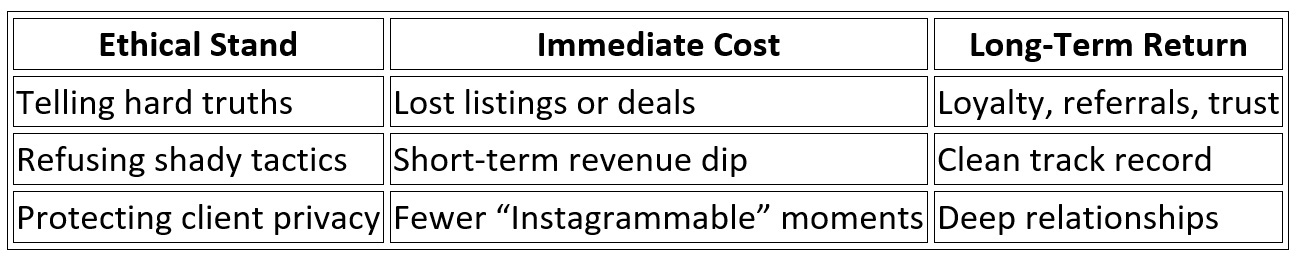
The Pattern Is Always the Same
You pay now.
You gain later.
And the only proof it’s worth it?
→ Your own alignment
→ The trust others slowly place in you over time
There’s a reason people call you “the one who tells the truth.”
That doesn’t come from branding. It comes from boundaries.
Seasonal Reflection
This is the month where reflection starts quietly:
Holidays are near
Business cools
Relationships stretch thin
But this is also the moment to ask:
“What did I refuse to compromise this year?”
“What did it cost?”
“And what did it prove about who I really am?”
That cost?
It’s not failure.
It’s proof of credibility.
👉 Inside the Vault for Paid Subscribers:
A real-world case study from a Virginia agent who walked away from a big developer listing
A tool to help you decide when it’s worth it: The Values-Based Decision Grid
Next week in Part 4: Shelter in the Storm, how to re-engage and recover when your stand, your story, or your silence takes a toll.
