

The Real Fear Is Not AI. It Is Becoming Irrelevant
Why many real estate professionals are discovering that the real pressure is not learning AI tools, but learning how to remain clear, trusted, and understandable in a faster-moving industry.

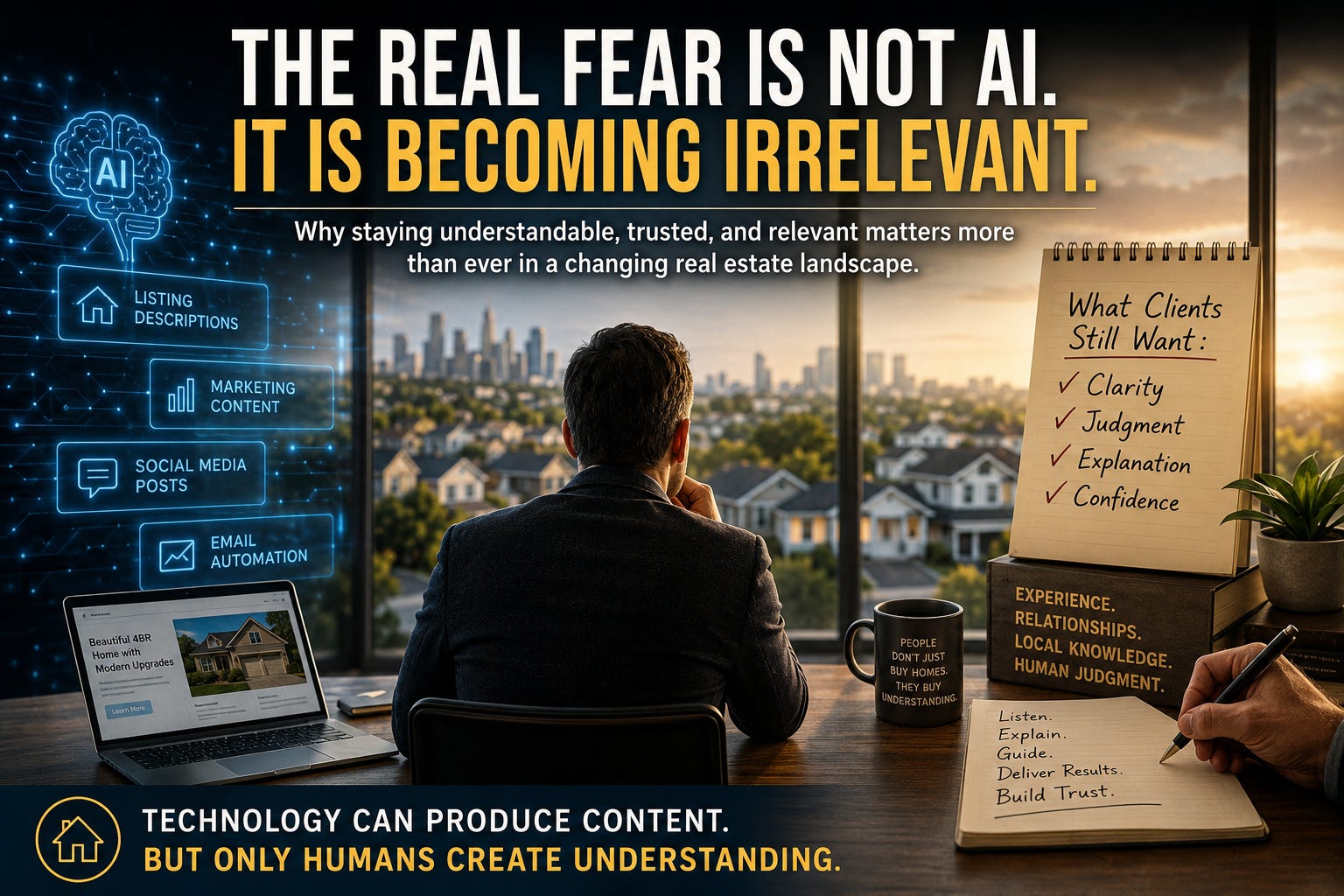
A Conversation Bigger Than Technology
The conversation started with an email from veteran copywriter Bob Bly.
The subject line asked a blunt question:
“Will AI force you to pivot to a new career?”
Inside the email, he reflected on why adapting to new technology becomes harder for some professionals later in life. He mentioned familiarity, risk tolerance, professional identity, and the discomfort that comes with changing routines built over decades.
At first glance, it looked like a discussion about artificial intelligence.
But the more I thought about it, the more it seemed to describe something happening quietly across real estate.
Because many real estate professionals are not simply navigating technology changes.
They are navigating identity changes.
The Industry Is Moving Faster Than Old Communication Habits
For years, an agent’s value may have been tied to things that felt stable and understandable:
local knowledge, relationships, MLS access, in-person networking, open houses, referrals, market experience, negotiation skill, and years spent learning how transactions actually work.
Then the environment shifts.
Buyers search properties before speaking to an agent.
Consumers compare schools, neighborhoods, taxes, and market trends online.
Listing descriptions can now be generated instantly.
Social media rewards visibility more than experience.
Video replaces long explanations.
AI tools create marketing material in seconds.
The pressure is no longer only about knowing real estate.
Now the pressure includes learning how to remain visible, understandable, and trusted inside a faster communication environment.
That changes people.
And the effect often shows up in writing before it shows up anywhere else.
Where The Pressure Starts Showing Up
You can see it in listing descriptions overloaded with disconnected features because the agent is trying to prove value quickly.
You can see it in agent profile pages filled with certifications, awards, and slogans but missing any explanation of how the agent actually works with buyers or sellers.
You can see it in client emails that contain correct information but still leave the reader confused about what happens next.
Most of these are not intelligence problems.
They are translation problems.
The professional understands the work completely because they live inside it every day. But the reader does not.
And during periods of industry change, that communication gap becomes more dangerous because buyers and sellers already feel uncertain themselves.
The Real Fear Beneath The AI Conversation
This is why the conversation around AI often misses the deeper issue.
The real fear is not usually the technology itself.
The real fear is becoming harder to understand in a world moving faster than your communication habits.
That fear affects newer agents and experienced agents differently.
A newer agent may worry:
“How do I compete if everyone has the same tools?”
An experienced agent may worry:
“How do I explain my experience in a way people still value?”
Both problems eventually return to communication.
Because readers are not asking whether your listing was written with AI.
They are asking:
“Can I follow this?”
“Do I understand this person?”
“Do I trust how this is being explained?”
“Can I picture what happens next?”
What Readers Still Want
A buyer scrolling through a listing still wants to understand how the house actually works. A seller still wants someone to explain why the property is not moving. A client still wants to know what happens next after the inspection, financing approval, or appraisal.
The tools may change, but people still look for clarity, judgment, explanation, and confidence.
Technology can speed up production.
It does not automatically create understanding.
That is where many professionals underestimate what clear writing actually does.
Clear communication is not decoration.
It is orientation.
It not only helps buyers picture movement through a property, but also:
helps sellers understand process.
helps clients understand sequence.
helps readers understand judgment.
helps professionals remain understandable while the industry changes around them.
Why Clarity Becomes More Valuable During Change
And that may become even more important as automation increases.
Because when more content becomes faster and easier to produce, readers become less patient with confusion.
That changes the value of communication entirely.
The advantage no longer comes from simply producing information.
The advantage comes from making information easier to follow than everyone else.
That is not old-school.
And it is not anti-technology.
It is adaptation.
The professionals who stay relevant will probably not be the loudest people online, nor the people using the most software.
They will be the professionals who continue helping readers feel oriented, informed, and clear during uncertain moments.
That applies to:
Property listings.
Profile pages.
Client communication.
Deal summaries.
Market updates.
Emails.
Conversations.
Everything.
Because long before someone hires you, calls you, or trusts you, they are already trying to understand you through the words in front of them.
And when the reader has to stop and figure things out on their own, they usually move on quietly.
Request A Review
If you want a second set of eyes on your listing description, agent profile page, deal summary, or client communication, request a review here:
Real Estate Writing Review Request
See you on the porch.
— Delroy
About the Author
Delroy A. Whyte-Hall is a real estate writer and the founder of Whyte-Hall Communications Network. He writes real estate documents agents use in their public relations and marketing efforts, including listing descriptions, agent profile pages, deal summaries, press releases, and case histories used across MLS listing pages, brokerage websites, and client communication. His work focuses on explaining what happened, how it was handled, and how the information is structured so buyers, clients, and third parties can understand it without having to interpret or guess.